Newsfeed

Oppositionist MP tells about how Armenian president's brother started as a driver and became a multimillionaire

Speaker of Armenian parliament offers to direct the report of the Audit Chamber to Prosecutor General's office

Expert: Presidential elections in Iran have made a surprise for the international community

Hospitals in Armenia cash in on patients

ARFD: If those engaged in abuse and flaws are not brought to responsibility, parliamentary hearings will become a simple show

Russian expert: Cooperation between Tehran and Yerevan will continue strengthening along with further deterioration of Iranian-Azeri relations

Expert: New president of Iran seeks to establish a dialogue with the West, but has no intention to give up the nuclear program

Thies Clemenz: HSBC Bank Armenia is still focused on the growth of the economy

Stepan Sukhorenko: For 20 years of diplomatic relations establishment our partnership has become more effective than during the USSR

Employees of Kilikia Commercial Center picketing Parliament of Armenia

F1 grenade found in area of ArmRusgasprom Company's offices

Armenian Defense Ministry: Son of the Head of the Armed Forces General Staff did not beat anyone

Visit of OSCE CiO to Armenia and Azerbaijan postponed for unknown period of time

Barev, Yerevan Faction refuses from official car

Rostelecom: In five years number of internet users in Armenia has grown by 50-60 times

Visit of OSCE CIo to Armenia and Azerbaijan postponed

NKR FM: Azerbaijan must change its position in Nagorno-Karabakh peace process

United States welcomes Armenia's progress in combating corruption

MP: Offshore scandal is part of the regime's plot to sacrifice Tigran Sargsyan in order to keep its power pyramid intact

Ruben Vardanyan: Armenia is a monoethnic state with a clan regime

Russia, United States and France to make a joint statement on Nagorno- Karabakh during G8 summit
Playwright Vrezh Israelyan commits suicide

Rostelecom launches night internet service

Opposition MP does not believe that the case of gunfight near the house of former governor of Syunik will be fully investigated

Head of ARFD Faction compares today's Armenia with Soviet Union under Brezhnev

PM: Negative mass media reports impede government work

Expert: Armenia reaches high level Viral Safety of blood donation

Republican Party of Armenia recommends Bryza to refrain from statements on Karabakh discrediting himself

Alexander Krylov: Both the OSCE MG co-chairs and the populations of Armenia and Azerbaijan have got tired of the status quo in Nagorno-Karabakh

Exclusive

Thies Clemenz: HSBC Bank Armenia is still focused on the growth of the economy

Stepan Sukhorenko: For 20 years of diplomatic relations establishment our partnership has become more effective than during the USSR

Alexander Krylov: Both the OSCE MG co-chairs and the populations of Armenia and Azerbaijan have got tired of the status quo in Nagorno-Karabakh

Vladimir Yevseev: The interests of separate corporations in foreign policy of Russia sometimes are put above the state ones

Gagik Harutyunyan: New form of genocide through self-annihilation has been launched in Iraq and Syria

Samvel Farmanyan: To make progress in the negotiations, the parties should sign a treaty of the non-resumption of military action

Alexander Zinker: Strengthening its bases in the South Caucasus, Russia will keep reshaping the pro-Western policy of Georgia and Azerbaijan

Armen Martirosyan: Another situation similar to death of soldier Luks Stepanyan may spark a revolution in Armenia

Hovanes Igityan: Today’s Armenia reminds me of the last years USSR

Marat Terterov: Armenia’s long term security will be better served by strengthening economic security, rather than defining national security on the basis of the Tsarist Russian catch-cry “armiya i flot”

Avigdor Eskin : Armenia may play an important role in establishing a dialogue between Israel and Iran

Vahan Shirkhanyan: Armenia’s economic development and integration prospects may be connected with the European Union only virtually

Mikayel Hayrapetyan: The West cannot change power in Armenia yet

Andrey Areshev: There are objective restraints to the United States’ policy in Armenia

Bulgarian Ambassador to Armenia is pleased with cooperation between two countries

“Karabakh”: impulses, reality, and forecasts

  • by David Stepanyan

  • Tuesday, January 15, 20:52


 Latest impulses and forecasts regarding the Karabakh peace process are directly linked to the January 28 meeting of the Armenian and Azerbaijani foreign ministers in Paris. The Minsk Group mediators are supposed to submit some new ideas to Nalbandian and Mammadyarov. It is not known, however, what particular ideas they will offer.  Baku and Yerevan, the OSCE MG mediators will further keep in secrecy the details of the negotiations on the Karabakh conflict within the so-called Madrid Principles. The parties are supposed to bargain on a common denominator in the most sensitive issues of the peace process. The notorious details of the “Principles” are not made public, which makes it possible for the Armenian and Azerbaijan authorities to use the Karabakh issue in the domestic policy. It is noteworthy that all this is happening upon sufferance of the Minsk Group co-chairs, which is disturbing.


Azerbaijani Milli Mejlis Speaker Bahar Muradova’s statement has confirmed Azerbaijan’s unwillingness to continue the negotiations within the OSCE MG. Muradova said recently that Azerbaijan still relies of the Helsinki Final Act and that “settlement of the conflict only within the OSCE is impossible.”  Obviously, in the face of the current trends and realities, Baku tries to boost the Minsk Process by traditional “oil and gas” methods. Nevertheless, the Azerbaijani authorities seem to have finally realized that relatively inexpensive oil and gas does not bring the stances of the three co-chairs closer, but paradoxically impedes the process.  Fortunately, lack of consensus between Paris, Washington and Moscow on the Karabakh peace process and on other global issues seems not so favorable to Baku. Everyone understands now that EU, USA and Russia together can influence not only the Karabakh conflict but also other processes in the region in case of desire.  However, Russia is not ready to recognize the EU as the regional actor and takes exception at European initiatives, such as the Eastern Partnership Project, for instance. Moscow has a similar approach to Washington.


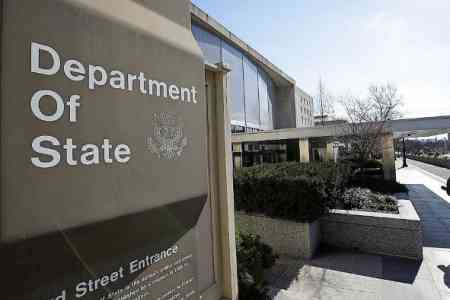
The statement by Victoria Nuland, spokesperson for the United States Department of State, has once again confirmed the USA’s interest in the settlement of the Karabakh conflict. She said that the U.S. tries to actively cooperate with Russia also in regional issues such as the situation in Nagorno Karabakh. For his part, Jonas Stewart, spokesperson of the U.S. Embassy in Azerbaijan said that the U.S. still considers of the OSCE MG the optimal format of international mediation in the Karabakh peace process. That is why Baku strives to give an impulse to the failing process. Azerbaijani Foreign Ministry Spokesperson Elman Abdullayev has already declared that despite the upcoming presidential elections in Armenia and Azerbaijan, the negotiations for resolution of the conflict will not be stopped. Azerbaijan believes that there are still diplomatic methods of settling the conflict. It is noteworthy that the given statement is addressed to Russia, USA and Europe.


The Iranian specialist in Caucasus Hassan Beheshtipour believes that Baku will just aggravate the Karabakh issue by providing oil concession management to Russian and American companies to settle the Karabakh conflict in its favor without a conflict of interests of Washington and Moscow. With Ilham Aliyev’s coming to power Russia’s influence in Azerbaijan has decreased. Alongside with that the pro-Western political elite in Azerbaijan has strengthened its positions. The last step was the closedown of the Gabala radar station in Azerbaijan. One can arrive at a conclusion that Azerbaijan’s strategy aims to gradually reduce Russia’s influence in its territory. In this light, it is logical to say that trying to oust Russia from its territory Baku will hardly be interested in Russia’s co-chairmanship of the OSCE MG.


The December 12 critical report of the PACE Monitoring Committee predicts nothing good for Baku from the French-European co-chairmanship either. It becomes obvious also from the unusual harsh criticism of Baku for not fulfilling the commitments to the Council of Europe and the accompanying recommendations by the co-rapproteurs on Azerbaijan. The report became the logical continuation of PACE’s general course on Azerbaijan adopted at the last session of the CoE on October 3. Then European parliamentarians adopted resolutions on the ideas of political prisoners and “caviar” diplomacy.  Hence, the bright past of PACE-Azerbaijan relations have been replaced with thunderous future.  Due to USA’s unwillingness to change the format of the Minsk Group, the situation has become quite unfavorable for Azerbaijan. Aliyev’s entourage have realized that the “big game” in the South Caucasus began to gradually develop into an active phase, and the regrouping of forces and revision of the spheres of influence will undoubtedly influence the conflict’s settlement process.


Therefore, Baku has nothing to do but hope for a change in the staff of the Minsk Group, and the co-chairs on the Karabakh process. Baku’s preferred candidates for co-chairmanship of the Minsk Group is the fraternal Turkey and Great Britain that lacks friends but has interests in the oil and gas sector. This viewpoint was confirmed by Dennis Sammut, Director of LINKS NGO, who in his speech at the OSCE Conference in Brussels called for convening a Minsk conference to elaborate steps leading to peaceful resolution of the Karabakh conflict. Looking deep into the given suggestion one can understand that the British initiative that aims to change the format of the OSCE MG may lead to neutralization of its work, which is not in favor of either Azerbaijan or Turkey. Neither it is favorable of the Great Britain.


It appears that the policy of maintaining the status-quo around the Karabakh conflict, which Moscow is accused for, will be continued irrespective of the format of the MG. Azerbaijan is not allowed to launch new aggression against Karabakh either by Russia, which does not need a new headache on the southern borders, or by the West that protects its huge investments in the energy projects in Azerbaijan.  It is especially relevant considering that the regional superpowers, Iran, which supports Armenia, and Turkey that openly supports Azerbaijan, automatically create additional strong basis for the balance of forces for maintenance of the status-quo. In this light, one should expect neither a comprehensive treaty on Karabakh nor changes in the OSCE MG in the foreseeable future. 

Send to a friend

To (e-mail)


Your name


Message


Comments

View comments (0)
  • READ ALL COMMENTS
  • POST A COMMENT

Be first to comment on this article

* Indicates required fields
Image of the day
Dinosaur